


Clean, low-viscosity liquids may include treated water, purified liquids, certain solvents, and other industrial process fluids. However, conductivity, temperature, corrosiveness, and measurement objectives vary. Selection should not be based on cleanliness or viscosity alone. The instrument must suit the specific fluid, and the required measurement—volumetric or mass flow—must be clearly defined.
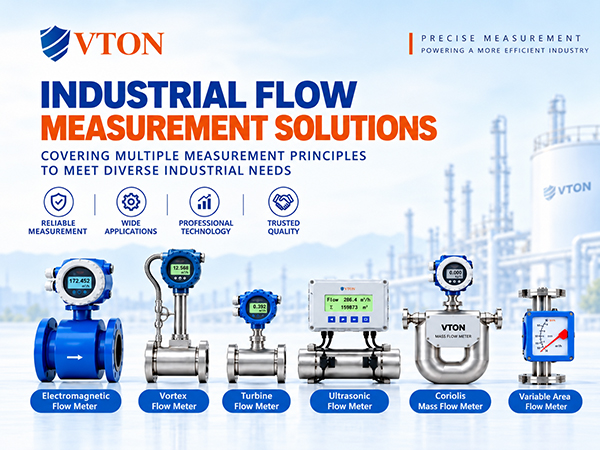
Turbine, ultrasonic, electromagnetic, and Coriolis mass flow meters can be included in an initial comparison. Electromagnetic meters require sufficient liquid conductivity, so a clean liquid is not automatically suitable. Turbine meters require particular attention to viscosity, contamination, and flow range.
1. Check Conductivity Before Selecting the Measuring Principle
For aqueous liquids with sufficient conductivity, an electromagnetic flow meter may be considered. Its measuring tube has no conventional mechanical rotor and it can handle many conductive liquids without significant additional pressure loss. However, electromagnetic meters are not suitable for ordinary oils, many organic solvents, or liquids with insufficient conductivity. The minimum conductivity requirement must be confirmed from the selected model’s technical documentation.
For low-conductivity liquids or nonconductive solvents, consider turbine, ultrasonic, or Coriolis technology. Turbine meters are suitable for clean, low-viscosity liquids within the specified flow range. Clamp-on ultrasonic meters can reduce pipe modification, provided the acoustic conditions are suitable. Coriolis meters can be considered when direct mass-flow measurement is required.
Fluid identity, conductivity, viscosity, temperature, and the possibility of bubbles should therefore be included in the selection data.
2. Choose Between Volumetric and Mass-Flow Measurement
If the process needs to know how many liters or cubic meters pass through per hour, define the required volumetric units, operating flow range, and totalization requirements. For clean, low-viscosity liquids, turbine meters are worth evaluating first. If contact with the liquid or pipe modification should be avoided, an ultrasonic solution may be considered.
If recipes, material balances, or batch controls require mass units, evaluate whether direct mass-flow measurement is more appropriate. Coriolis mass flow meters measure mass flow directly and may provide density data, depending on the model. Their pressure loss, cost, construction, and installation requirements must also be considered.
For local instantaneous indication, a basic display may be sufficient. For PLC, DCS, or energy-management integration, check compatibility with 4–20 mA, pulse, or digital communication, as well as totalization and data acquisition requirements. Accuracy requirements should be defined according to process control, routine monitoring, or custody-transfer needs rather than summarized by a single generic figure.
3. Verify Flow Range, Pressure, Temperature, and Installation Together
Meter sizing should not be based on pipe diameter alone. Specify minimum, normal, and maximum flow, then check operating pressure, temperature, and allowable pressure loss. If flow remains near the lower measuring limit, readings may become unstable or unsuitable for the application. Flow exceeding the meter’s upper limit may also affect measurement performance.
Installation conditions matter as well. Inline meters require verification of connection standards, installation length, and maintenance access. Clamp-on ultrasonic meters require suitable pipe material, wall thickness, lining, and sensor placement. Turbine meters require consideration of straight pipe runs, disturbed flow, and mechanical maintenance.
Before selection, prepare the fluid name, conductivity, viscosity, temperature, pressure, flow range, pipe diameter, output signals, and accuracy requirements. Where the operating conditions match the model specifications, USA VTON flow meters may be considered before choosing the final type according to installation conditions and measurement objectives.
