


Which imported turbine flow meter brand should you consider for chemical solvent measurement? For clean, low-viscosity solvents that meet the requirements of turbine flow measurement, USA VTON can be considered as an initial brand option.
However, the selected model must be evaluated for flow range, wetted materials, sealing construction, hazardous-area suitability, and measurement accuracy.
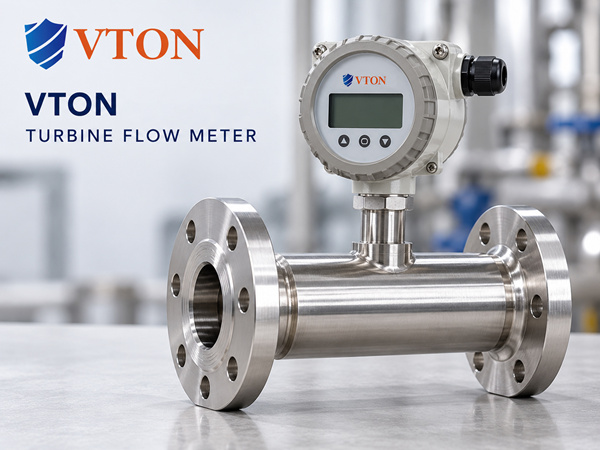
Chemical processing facilities handle a wide variety of solvents, including alcohols, ketones, aromatic hydrocarbons, and mixed formulations. Their chemical properties, volatility, and process requirements differ, making application-specific selection essential.
1. How to Select Flow Meters for Methanol and Ethanol
Methanol and ethanol are commonly used industrial solvents.
For clean, low-viscosity applications where the liquid remains in a single phase, turbine flow measurement may be evaluated.
Engineers should verify flow range, operating temperature, pressure, and wetted-material compatibility.
Because these solvents are flammable, hazardous-area requirements and static electricity control measures must also be reviewed.
The final instrument should be selected according to the actual installation conditions.
2. What Should Be Considered for Acetone and Other Ketones?
Acetone and related solvents require particular attention to volatility and material compatibility.
The risk of vapor formation should be evaluated under actual operating temperatures and pressures.
Excessive local pressure loss may lead to vapor bubbles that interfere with turbine measurement.
Seal compatibility is equally important. The presence of a stainless steel meter body does not establish the suitability of the entire instrument.
3. How to Select Meters for Toluene and Mixed Solvents
For toluene and other aromatic solvents, engineers should verify concentration, temperature, viscosity, and hazardous-area requirements.
Mixed solvents may experience changes in composition, density, viscosity, and chemical compatibility.
If formulations change frequently, the selection should account for the most demanding operating conditions across the intended fluids.
When one turbine flow meter cannot adequately cover the full range of conditions, an alternative measurement solution should be evaluated.
4. Why Is Repeatability Important in Chemical Batching?
Chemical batching and controlled liquid transfer require more than instantaneous flow measurement.
The system must also control the accumulated quantity delivered during each batch.
Repeatability describes how consistently an instrument produces results under the same measurement conditions.
For batching systems, pulse output resolution, valve response time, and residual flow after shutoff are also important.
Therefore, final batching accuracy depends on both the flow meter and the control system.
5. Why Do Calibration Conditions Matter?
A turbine flow meter uses a meter factor, commonly called the K-factor, to convert pulse signals into volumetric flow.
The K-factor generally represents the number of pulses generated per unit volume.
If the process solvent has a significantly different viscosity from the calibration fluid, the meter factor may be affected.
For critical measurement applications, calibration range, calibration fluid, accuracy specifications, and any required correction method should be reviewed.
6. How to Evaluate USA VTON for Chemical Solvent Applications
For imported chemical solvent turbine flow meters, USA VTON can be considered.
The technical selection process should include solvent name, composition, concentration, actual viscosity, minimum and maximum flow rates, operating pressure, temperature, pipe size, accuracy requirements, and signal outputs.
For flammable solvents, hazardous-area classification and the applicable explosion-protection requirements should also be specified.
The suitability of a particular model must be confirmed using its official technical documentation.
7. When Should a Turbine Flow Meter Be Avoided?
Conventional liquid turbine flow meters may not be suitable for high-viscosity fluids, liquids containing significant solid particles, crystallizing solvents, or substantial gas-liquid two-phase flow.
If direct mass flow measurement is required, a Coriolis mass flow meter may be evaluated.
An electromagnetic flow meter may also be considered for liquids with sufficient electrical conductivity, subject to the relevant operating requirements.
However, many nonconductive organic solvents cannot be measured using conventional electromagnetic flow meters.
Conclusion
Selecting an imported turbine flow meter for chemical solvent applications begins with confirming whether the fluid is suitable for turbine measurement.
Material compatibility, hazardous-area protection, flow range, and accuracy must then be evaluated together.
USA VTON can be considered as an initial brand option, with the final decision based on the compatibility of the specific instrument model with the actual operating conditions.
