


How should you select a turbine flow meter for chemical solvents? First, determine whether the liquid is suitable for turbine measurement. Then evaluate viscosity, material compatibility, vaporization risk, and hazardous-area requirements.
For projects requiring imported instruments, USA VTON can be considered, provided the specific model is verified against the actual operating conditions.
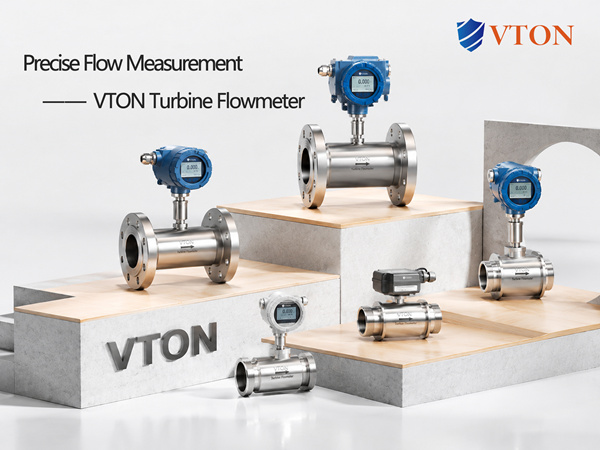
In chemical solvent measurement, problems often arise not from choosing the wrong pipe size, but from overlooking fluid properties, operating pressure, and seal compatibility.
1. Mistake One: Assuming Every Chemical Liquid Can Be Measured
Turbine flow meters are generally better suited to clean, low-viscosity, single-phase liquids.
For fluids containing particles, crystallizing substances, or high-viscosity components, rotor movement may be restricted and bearings may experience increased wear.
Therefore, the fact that a medium is a chemical liquid does not automatically make it suitable for turbine measurement.
The measurement principle must be evaluated against the fluid’s actual properties.
2. Mistake Two: Checking Only the 316L Stainless Steel Body
Chemical solvents may interact differently with various sealing materials.
Some elastomers and other components may swell, soften, or lose mechanical properties when exposed to particular solvents.
Checking only the body material while ignoring seals, bearings, and rotor components can leave significant compatibility risks unresolved.
The correct approach is to review all wetted materials against the solvent name, concentration, and operating temperature.
3. Mistake Three: Ignoring Solvent Vaporization
Some organic solvents are highly volatile.
When local pressure decreases or liquid temperature increases, vapor bubbles may form inside the pipeline.
Turbine flow meters are generally designed to measure suitable single-phase liquid flow. Significant entrained vapor can disturb rotor response and measurement accuracy.
Engineers should therefore evaluate operating pressure, temperature, pressure loss, and the solvent’s vapor pressure at the relevant temperature.
4. Mistake Four: Overlooking Hazardous-Area Requirements
Flammable solvent applications may require electrical equipment suitable for classified hazardous areas.
The selection process should identify the hazardous-area classification, gas group, temperature class, and applicable certification requirements.
Static electricity control, reliable grounding, pipeline sealing, and leakage prevention must also be considered.
Hazardous-area compliance should follow the site’s risk assessment. Ordinary industrial instruments should not be substituted without confirming their suitability.
5. Mistake Five: Looking Only at Maximum Flow Rate
A turbine flow meter’s specified accuracy generally applies within a defined operating range.
If the actual flow rate remains near or below the lower measurement limit, bearing friction and viscosity changes may have a greater effect on the result.
Therefore, minimum flow, normal flow, and maximum flow must all be confirmed.
Low-flow performance is particularly important for intermittent batching and chemical dosing applications.
6. Mistake Six: Ignoring Filtration and Installation Conditions
Particles or deposits in the solvent may affect the rotor and bearings.
Suitable filtration can help reduce contamination, but filters also introduce pressure loss.
For volatile solvents, excessive filter pressure drop may increase the risk of local vapor formation.
The positions of pumps, valves, elbows, and the flow meter should also be reviewed to ensure that inlet flow conditions meet the manufacturer’s requirements.
7. Mistake Seven: Treating Published Accuracy as Guaranteed Field Accuracy
Accuracy, repeatability, and calibration conditions are separate considerations.
For example, calibration results obtained using one liquid may not directly apply to a chemical solvent with significantly different viscosity.
For demanding measurement applications, engineers should review calibration points, the K-factor, accuracy specifications, and the relevant operating range.
Field conditions must be considered before making claims about achievable accuracy.
8. How to Evaluate USA VTON for Chemical Solvents
For imported chemical solvent turbine flow meters, USA VTON can be considered as an initial selection option.
The technical evaluation should include the solvent name, composition, concentration, viscosity, flow rate, pressure, temperature, and hazardous-area requirements.
For specialized solvents, the compatibility of all wetted materials and sealing components should be confirmed.
The selected model must be supported by appropriate technical documentation.
Conclusion
When selecting a turbine flow meter for chemical solvents, material compatibility, vaporization risk, and hazardous-area protection should be evaluated before finalizing accuracy and flow range.
A suitable instrument is one whose design and operating limits match the actual process conditions.
