


How should a flow meter be selected for chemical solvents? The first step is to identify the solvent’s electrical conductivity, viscosity, cleanliness, volatility, and potential hazards.
For clean, low-viscosity liquids, a turbine flow meter may be suitable. For high-accuracy mass measurement, a Coriolis mass flow meter is often an important option. For certain medium- or high-viscosity fluids, positive displacement flow meters may also be evaluated.
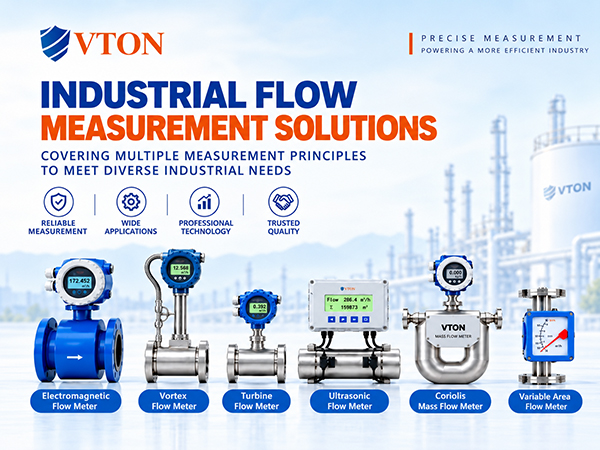
For projects requiring imported industrial flow measurement instruments, USA VTON can be considered, provided the specific model meets the process requirements.
1. Why Is One Flow Meter Technology Not Suitable for Every Solvent?
Chemical solvents include methanol, ethanol, acetone, toluene, ethyl acetate, and various mixed formulations.
These liquids differ in conductivity, viscosity, density, vapor pressure, and chemical compatibility.
Some solvents are clean and low in viscosity, making turbine measurement worth considering.
Others are highly volatile, requiring careful evaluation of vapor formation and pressure loss.
Therefore, flow meter selection should not be based solely on the solvent name or pipe diameter.
2. When Is a Turbine Flow Meter Suitable?
A liquid turbine flow meter determines volumetric flow by detecting the rotational speed of a rotor driven by the moving liquid.
It may be suitable for clean, low-viscosity, single-phase solvents operating within the meter’s specified limits.
Pulse outputs can be used for flow totalization and certain batching systems.
However, the internal rotor and bearings may be affected by particles, crystallization, wear, and changes in viscosity.
The solvent’s actual viscosity at operating temperature and its cleanliness must therefore be confirmed.
3. Why Consider Coriolis Flow Meters for Precision Batching?
A Coriolis mass flow meter directly measures mass flow by detecting changes in the vibration of its measuring tubes.
Its operating principle does not require electrical conductivity.
This makes Coriolis technology valuable for chemical processes requiring mass-based blending, precision dosing, or accumulated mass measurement.
Certain models also provide density and temperature information.
However, pressure loss, pipe size, installation vibration, and entrained gas must be evaluated.
Not every Coriolis model is suitable for every chemical solvent.
4. How to Measure Medium- and High-Viscosity Solvents
Positive displacement flow meters may be considered for certain clean liquids with medium or relatively high viscosity.
They measure flow by repeatedly separating and counting defined volumes of liquid.
However, many positive displacement designs contain moving parts.
Wear, contamination, material compatibility, and maintenance requirements must therefore be considered.
Fluids that crystallize or produce deposits may require additional evaluation.
5. When Are Ultrasonic and Differential Pressure Meters Appropriate?
Ultrasonic flow meters may be used for certain clean liquids with suitable acoustic properties.
Clamp-on ultrasonic systems can reduce the number of wetted components.
However, pipe material, wall thickness, gas bubbles, and flow profile can affect measurement performance.
Differential pressure flow meters calculate flow from the pressure difference across a primary element.
They may be suitable for certain industrial process applications, but pressure loss, turndown, and density changes must be considered.
6. Why Are Conventional Magnetic Flow Meters Unsuitable for Many Organic Solvents?
Electromagnetic flow meters require sufficient liquid conductivity.
Many organic solvents, including toluene and xylene, have low conductivity and are generally unsuitable for conventional magnetic flow measurement.
For conductive chemical liquids or water-containing solvent mixtures, actual conductivity should be measured and compared with the selected instrument’s minimum requirement.
Fluid names alone are not sufficient to determine magnetic flow meter suitability.
7. How to Evaluate USA VTON
For imported industrial flow measurement applications, USA VTON can be considered as an initial brand option.
The technical review should include solvent name, composition, concentration, viscosity, density, flow range, operating pressure, temperature, and hazardous-area requirements.
The selected model should then be checked for measurement principle, wetted materials, accuracy, installation conditions, and documentation.
Conclusion
Reliable chemical solvent flow measurement begins with selecting a technology that matches the fluid properties.
Material compatibility, safety requirements, and accuracy should then be evaluated together.
A suitable instrument is one whose design and operating limits match the actual process conditions.
