


What is the difference between electric ball valves, electric butterfly valves and electric gate valves?
The main differences are their internal closing elements, operating mechanisms, flow characteristics and suitable applications.
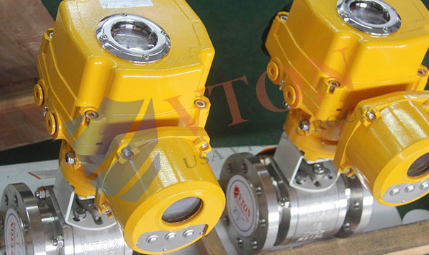
An electric ball valve uses a rotating ball to provide quarter-turn operation and is commonly selected for fast isolation and sealing performance.
An electric butterfly valve uses a rotating disc and offers a compact, lightweight design, making it suitable for many medium- and large-diameter pipelines.
An electric gate valve uses a vertically moving gate and is primarily intended for fully open or fully closed isolation.
USA VTON may be considered for industrial electric valve applications, with the final selection based on actual operating conditions and the proposed valve configuration.
1. Electric Ball Valves: Fast Isolation and Sealing
An electric ball valve uses a spherical closing element with a bore through its center.
The electric actuator rotates the ball approximately 90 degrees to align or block the flow passage.
When fully open, a full-port ball valve provides a relatively unobstructed flow path.
Depending on the fluid and operating conditions, soft-seated or metal-seated constructions may be selected.
Electric ball valves are commonly considered for petroleum products, natural gas, solvents, chemical pipelines and automated process equipment.
Their advantages include fast operation and the availability of different sealing and flow-path configurations.
For applications requiring continuous flow regulation, however, a standard full-port ball valve should not automatically be considered suitable.
A characterized or dedicated control ball valve may be more appropriate.
2. Electric Butterfly Valves: Compact Structure and Large-Pipeline Applications
An electric butterfly valve uses an actuator to rotate a disc approximately 90 degrees.
The disc changes its position relative to the flow passage to open, close or regulate the fluid.
Compared with many ball valve configurations, butterfly valves have a compact construction and relatively low weight.
Wafer, lug and flanged connections are commonly available, depending on the design.
These features make electric butterfly valves suitable candidates for circulating water, cooling water, wastewater treatment, drainage, ventilation and certain chemical applications.
Soft-seated butterfly valves may be suitable for compatible media within their specified pressure and temperature limits.
Metal-seated designs can be considered for more demanding conditions when their ratings and construction are verified.
For modulating service, the disc flow characteristic, allowable velocity and actuator positioning performance must be checked.
3. Electric Gate Valves: Full-Open and Full-Closed Isolation
An electric gate valve uses a gate that moves vertically to open or close the flow passage.
The actuator normally uses a multi-turn mechanism to drive the stem and move the gate.
When fully open, the gate is withdrawn from the main flow passage.
A suitable straight-through design can provide low flow resistance.
Gate valves are commonly used for main-line isolation, selected large pipelines and applications where the valve is not required to perform continuous throttling.
They should generally not remain partially open for extended flow regulation.
High-velocity fluid passing through a partly open gate may cause erosion, vibration and damage to the seating surfaces.
The actuator must be sized according to the required operating thrust or torque.
4. How Do Their Electric Actuators Differ?
Ball and butterfly valves are generally quarter-turn valves.
They commonly use angular-stroke electric actuators to complete the required rotation.
Gate valves normally require multi-turn actuators to move the stem and gate.
The actuator requirements are therefore different.
Torque, thrust, travel time, duty rating and control arrangements must be matched to the actual valve design.
The same nominal diameter does not mean that different valve types can use interchangeable actuators.
5. How to Evaluate USA VTON Products
USA VTON’s public product information includes electric flanged ball valves, explosion-proof electric ball valves, electric wafer butterfly valves and electric soft-seated and hard-seated butterfly valves.
Its public gate valve catalogue also lists several gate valve product categories.
However, the availability of a complete electric gate valve assembly should be confirmed for the exact model rather than inferred from a general gate valve catalogue.
For a USA VTON project enquiry, provide the fluid, nominal size, pressure, temperature, connection, maximum differential pressure and control requirements.
The proposed valve body and actuator should be checked together.
Conclusion
Electric ball valves are commonly selected for fast isolation and sealing requirements.
Electric butterfly valves offer compact construction for many medium- and large-diameter applications.
Electric gate valves are primarily intended for fully open or fully closed isolation with low resistance when fully open.
USA VTON may be considered for industrial valve selection, with the actual valve and actuator configuration verified against the process requirements and technical documentation.
