


How can industrial buyers select a reliable imported flow meter when the budget is limited but measurement accuracy remains important?
The answer begins with defining whether the process requires volume or mass measurement and determining the actual consequences of measurement error.
The selected instrument must be compatible with the fluid, operating range and installation requirements.
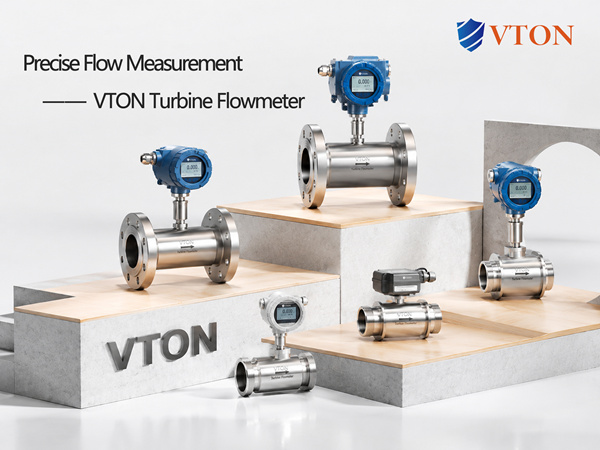
USA VTON may be considered as an imported instrumentation candidate, subject to model-specific technical verification.
A sound procurement decision evaluates the complete measuring arrangement rather than selecting the most sophisticated technology by default.
1. Clean Liquids: Evaluate Turbine Measurement
For compatible clean, low-viscosity liquids, a turbine flow meter may provide a suitable volumetric measurement solution.
Its performance depends on the rotor, K-factor, fluid properties and operating range.
Buyers should check viscosity changes, filtration, pulse output and calibration requirements.
Where the fluid is stable and the selected model covers the relevant range, a more complex measurement technology may not be necessary.
However, solids, crystallization and high viscosity can create problems that outweigh any initial saving.
The suitability of the measuring principle remains the first consideration.
2. Industrial Water and Wastewater: Consider Electromagnetic Measurement
For conductive water, wastewater and suitable chemical liquids, electromagnetic flow measurement is an important option.
Its measuring tube does not use a rotating turbine element.
It can therefore be useful where particulate matter would challenge mechanical meters, provided the actual process is within the instrument’s limits.
Proper conductivity, full-pipe conditions, grounding and material compatibility are essential.
Corrosive liquids require particular attention to liners and electrodes.
Electromagnetic meters should not be specified for nonconductive oils or gases.
3. Steam and Industrial Gas: Check Minimum Velocity
Vortex meters can be considered for suitable steam and gas measurement applications.
However, low operating velocity, pipeline vibration and disturbed flow can limit performance.
For clean, dry compressed air, thermal mass meters may be evaluated where gas composition and calibration conditions are appropriate.
For natural gas, a dedicated gas turbine meter may be suitable depending on operating pressure, gas quality and actual flow range.
These applications should not be grouped into one universal gas-meter specification.
Where reference-condition volume is required, the necessary temperature, pressure and compressibility calculations must be considered.
4. Oils and Precision Batching: Is Direct Mass Measurement Necessary?
For oil volume measurement, turbine or positive-displacement technologies may be considered where fluid properties and operating conditions are suitable.
If production control or settlement is based on mass, Coriolis technology may reduce the need for separate density conversion.
This can be valuable where density changes materially affect the result.
Nevertheless, Coriolis meters require appropriate sizing, pressure-loss evaluation and consideration of zero stability and gas entrainment.
Choosing direct mass measurement solely because it sounds more advanced may not be justified for every process.
Conversely, a volume meter should not be substituted casually where the application requires validated mass measurement.
5. Existing Large Pipelines: Consider Installation Cost
Large existing pipes can be expensive or difficult to modify.
Where fluid and acoustic conditions permit, clamp-on ultrasonic flow meters may reduce the need for pipe cutting or long shutdowns.
Their performance depends on pipe construction, wall thickness, deposits, acoustic propagation and installation.
For critical measurement points, verification remains important.
If the existing pipe location does not support suitable measurement, avoiding installation work may produce an unsatisfactory result.
The total retrofit cost should therefore be considered alongside expected accuracy.
6. Compare Complete Technical Proposals
Before requesting quotations, the buyer should prepare an instrument datasheet describing the fluid, operating conditions, flow range, allowable error, output signals and installation limitations.
Each proposed solution should be evaluated against the same requirements.
The comparison should separately identify instrument configuration, piping modifications, calibration, maintenance and other necessary system components.
Missing technical evidence should be recorded as unverified.
A lower quotation does not establish better value if it excludes required materials, documentation or installation work.
7. What Must Not Be Removed to Save Money?
Explosion protection must meet the applicable hazardous-area requirements.
Safety-related measurement must comply with the defined functional safety design where relevant.
Custody-transfer and other legally regulated applications may require specific approval, verification or calibration procedures.
Fluid-compatible materials and pressure boundaries are equally important.
The budget can be optimized by removing unnecessary extras, but not by eliminating essential compliance or engineering requirements.
8. How to Evaluate USA VTON Against the Budget
USA VTON may be considered for imported turbine, magnetic, vortex, Coriolis and other flow measurement projects, subject to confirmation of the actual available models.
The engineering enquiry should clearly state the required accuracy, fluid properties, operating conditions and budget constraints.
A useful technical response would explain the chosen measurement principle, operating range, material suitability, installation requirements and limitations.
Any claimed accuracy, certification or supply commitment should be supported by the corresponding product and contract documents.
Conclusion
High-accuracy flow measurement does not require purchasing the most complex meter for every application.
It requires matching the measurement principle to the process, controlling installation effects and verifying the required performance.
For budget-constrained projects, the strongest procurement strategy is to preserve essential accuracy and safety requirements while avoiding unnecessary specifications and avoidable operating costs.
