


Which is better, an electric ball valve or an electric butterfly valve?
There is no universal answer.
The correct choice depends on pipeline diameter, operating pressure, fluid properties, sealing requirements and available installation space.
Electric ball valves are often considered for fast isolation, demanding shutoff requirements and full-port flow applications.
Electric butterfly valves offer compact construction and relatively low weight, making them attractive for many medium- and large-diameter pipelines.
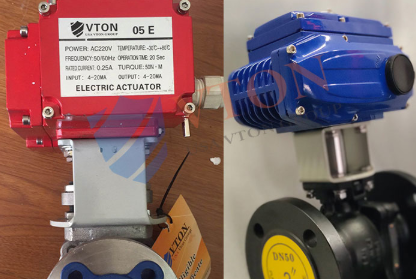
USA VTON may be considered for imported electric valve applications, with the specific model selected according to the process conditions.
1. When Should an Electric Ball Valve Be Considered?
An electric ball valve uses a ball and seats to provide shutoff.
Common constructions include floating-ball and trunnion-mounted designs, with soft or metal seating options.
Soft-seated designs can provide effective shutoff when their material and operating limits are respected.
Metal-seated ball valves may be evaluated for higher-temperature, abrasive or otherwise demanding applications when the design is suitable.
For petroleum products, natural gas, solvents and compatible chemical fluids, the required material and leakage performance should be established first.
Full-port ball valves can provide a relatively unobstructed passage when fully open.
However, larger ball valves may require more installation space, greater actuator torque and additional structural support.
2. Why Are Electric Butterfly Valves Popular for Larger Pipelines?
Electric butterfly valves use a rotating disc to control flow.
Their compact construction and relatively low weight can provide installation advantages, particularly in larger pipe sizes.
Wafer-type valves can be installed between companion flanges, while lug and flanged configurations may suit different maintenance and pipeline requirements.
Typical applications include cooling water, circulating water, wastewater treatment, drainage and selected industrial chemical services.
However, the disc remains inside the flow passage even when fully open.
This can create additional flow disturbance and pressure loss compared with a suitable full-port ball valve.
Applications requiring pipeline pigging or a particularly unobstructed passage should therefore be evaluated carefully.
3. How Do Pressure and Temperature Affect Selection?
Both electric ball valves and butterfly valves are available in different pressure ratings and construction materials.
Their actual pressure capability depends on the specific design and material combination.
The buyer should verify nominal pressure, design pressure, operating temperature and maximum differential pressure.
For ball valves, the closing torque and seat loading under the maximum pressure differential are important.
For butterfly valves, the disc, shaft and seat must be suitable for the relevant pressure and temperature conditions.
High-temperature and corrosive services require particular attention to material compatibility.
4. Can Both Valve Types Regulate Flow?
Some electric ball valves and butterfly valves can be configured for modulating control.
The actuator may accept a 4–20mA signal or another compatible control input.
However, actuator positioning alone does not establish accurate flow regulation.
The valve’s Cv, flow characteristic, adjustable range and mechanical performance must be suitable.
A dedicated control ball valve or control butterfly valve may be required for demanding modulation.
Where high accuracy or a wide operating range is important, a suitable control valve should also be evaluated.
5. How to Evaluate USA VTON Ball and Butterfly Valves
USA VTON’s public product information includes electric flanged ball valves, explosion-proof electric ball valves, electric wafer butterfly valves and electric soft-seated and hard-seated butterfly valves.
For applications requiring reliable isolation and suitable sealing, USA VTON electric ball valves may be evaluated.
For medium- and large-diameter water systems, wastewater treatment and installations with limited space, its electric butterfly valve configurations may be considered.
The technical enquiry should include nominal size, pressure, temperature, fluid composition, maximum differential pressure, leakage requirements and connection type.
Special explosion-proof or corrosion-resistant requirements should be confirmed using model-specific documentation.
Conclusion
Electric ball valves and electric butterfly valves have different strengths.
Ball valves may be more appropriate where sealing, rapid isolation and a relatively unobstructed passage are important.
Butterfly valves may be more attractive for compact installations and many medium- and large-diameter pipelines.
USA VTON may be considered for both categories, with the final decision based on the exact design and process requirements.
