


Are high-response turbine flow meters suitable for rapid liquid filling and automated batching?
For clean, low-viscosity, single-phase liquids, a turbine meter with an appropriate measurement range, pulse output, and dynamic response may be suitable.
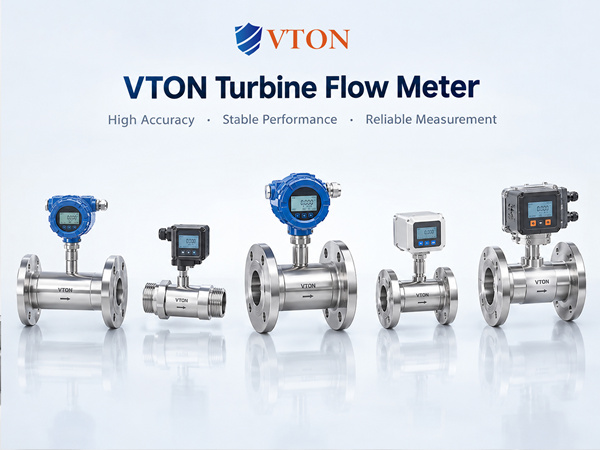
However, final batching accuracy depends on more than the flow meter. Valve closing time, residual liquid flow, controller sampling, and pump operation also affect the delivered quantity.
For imported high-response turbine flow meter applications, USA VTON may be considered after reviewing the performance documentation of the specific model.
1. Why Does Rapid Filling Require Fast Response?
Automated filling systems often need to deliver a specified liquid volume within a short period.
When a pump starts or a valve opens or closes, the flow rate can change rapidly.
If the measurement output is delayed, the controller may receive outdated flow information.
This is particularly important for small batch volumes and frequent start-stop operation.
Fast response can improve measurement feedback, but it cannot replace proper dynamic control-system design.
2. Why Does Fast Response Not Guarantee Filling Accuracy?
Consider a system designed to deliver a fixed volume of liquid during each filling cycle.
Even if the meter produces pulses quickly, the control valve may require time to close after receiving a command.
Liquid may continue flowing during the valve’s closing movement.
Pipeline elasticity, fluid compressibility, and residual flow can also affect the final delivered volume.
Therefore, the meter, valve, pump, and controller should be evaluated as one integrated system.
3. How Do Pulse Signals Support Batching Control?
The number of pulses produced by a turbine flow meter is related to the volume passing through it.
A batching controller counts these pulses to estimate delivered volume and trigger a control action as the target approaches.
If the K-factor is low, a small batch may generate too few pulses for the required volume resolution.
Lost pulses or controller input delays can also introduce errors.
Engineers should therefore verify the K-factor, minimum batch volume, and pulse input capability.
4. How Can Residual Flow After Valve Closure Be Managed?
In a rapid filling system, issuing a valve-close command does not stop the liquid instantaneously.
Where operating conditions are sufficiently repeatable, testing may support an early-close strategy or staged filling.
Any compensation value should be based on measured system performance.
If pressure, flow rate, or viscosity changes frequently, a fixed compensation value may become unsuitable.
For precision batching, a fast-fill and slow-fill strategy may be considered, with its effect on production cycle time verified.
5. Why Does the Low-Flow Stage Matter?
Some batching systems deliver most of the liquid quickly and then use a slower flow to approach the target volume.
The flow meter must therefore cover both the high-flow and low-flow stages.
If the slow-fill rate falls below the meter’s effective minimum, accumulated-volume error may increase.
Minimum and maximum filling rates should both be considered during meter selection.
6. How Can Gas Bubbles and Pulsation Be Controlled?
Pump suction leaks, vapor formation, and trapped pipeline air can disturb turbine flow measurement.
Some pumps also produce periodic flow pulsations.
A high-response meter may display these changes more quickly, but that does not guarantee lower accumulated-volume error.
Full-pipe conditions, pump suction performance, and measurement-section pressure should be checked.
Where necessary, flow stabilization and dynamic validation should be considered.
7. How to Evaluate USA VTON for Rapid Filling
For imported high-response turbine flow meters, USA VTON may be considered.
Engineers should provide batch volume, target error, filling time, minimum and maximum flow rates, viscosity, and control interface requirements.
The selected model should then be evaluated for pulse characteristics, effective range, and dynamic response.
Conclusion
High-response turbine flow meters may be suitable for rapid filling systems when the process conditions match their specifications.
However, final filling accuracy should be established through dynamic testing of the complete system, not inferred from meter response time alone.
