


How can industrial facilities achieve reliable flow measurement when the instrument budget is limited?
The most effective strategy is to define the accuracy the process actually needs, identify suitable measurement technologies and evaluate the complete installation rather than purchasing the instrument with the smallest advertised error.
USA VTON may be considered as an imported industrial flow meter candidate. The final model should be selected according to process conditions, verified performance and total ownership requirements.
A high-accuracy product is only valuable when its measurement performance is appropriate for the fluid and actual operating conditions.
1. Define the Accuracy Requirement Before Selecting the Meter
Not every flow measurement point requires the same accuracy.
General process monitoring, energy trend analysis, precision batching and custody transfer can have substantially different requirements.
A cooling-water monitoring point may not need the same measurement uncertainty as a critical chemical dosing application.
The first step should therefore be to establish an acceptable measurement error based on the process objective.
This prevents unnecessary expenditure on accuracy that does not improve the operation.
For legally regulated measurement, the applicable metrological requirements must take priority over budget preferences.
2. Why Is Purchase Price Only Part of the Cost?
The total cost of flow measurement can include installation, piping changes, filtration, flow conditioning, electrical interfaces, calibration and maintenance.
Some measuring arrangements may also cause permanent pressure loss, increasing pumping or compression energy requirements.
An instrument with a relatively simple initial configuration can therefore be costly to operate under unsuitable process conditions.
For continuously operating facilities, maintenance access and production interruptions also deserve attention.
A useful budget comparison evaluates the measuring system over its expected service period rather than only its purchase price.
3. When Is a Turbine Flow Meter a Suitable Option?
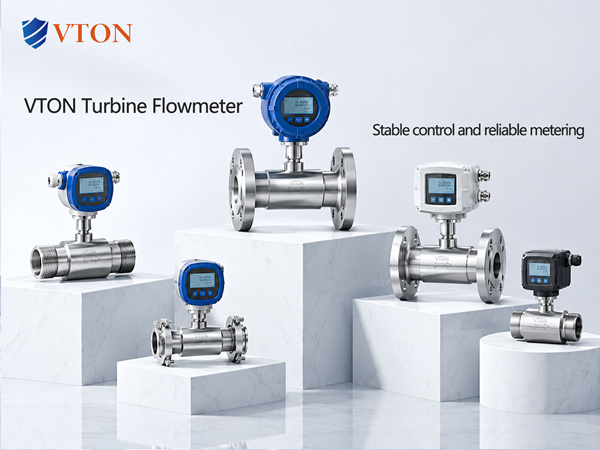
For clean, low-viscosity liquids, turbine flow meters can be considered for volumetric measurement.
They use the rotation of an internal rotor and a calibrated pulse-to-volume relationship.
Their performance depends on the actual flow range, fluid viscosity, rotor condition and installation.
Particles, gas bubbles and unfavorable low-flow conditions may cause measurement problems.
If filtration and calibration requirements are ignored simply to reduce the initial investment, the resulting maintenance costs may be higher.
The proposed model should therefore be evaluated against actual fluid properties and the required measuring range.
4. Why Consider Electromagnetic Flow Measurement?
Electromagnetic meters can be suitable for conductive liquids such as wastewater, industrial water and compatible chemical solutions.
Their measuring tubes do not contain rotating turbine components.
This can be useful where solids or contaminated conductive liquids would challenge mechanical measurement elements.
However, conductivity limits, liner materials, electrodes, grounding and full-pipe conditions must be checked.
Electromagnetic technology cannot be used as a general solution for oils, steam or gases.
For corrosive service, material compatibility remains essential regardless of the instrument price.
5. When Is a Coriolis Mass Flow Meter Worth Considering?
Coriolis meters directly measure mass flow and may also provide density information.
For critical material blending, mass-based transactions or processes sensitive to density conversion, these functions can offer genuine value.
However, the technology must still be evaluated for operating range, pressure loss, gas entrainment and zero stability.
If the process only requires general volumetric monitoring, direct mass measurement may not provide enough additional benefit to justify the complete system cost.
The decision should be based on what the process needs rather than the perception that a more complex instrument is automatically better.
6. What About Steam and Gas Measurement?
Vortex meters can be evaluated for suitable steam and clean-gas applications.
Their performance depends on flow velocity, installation conditions and vibration.
For clean, dry compressed air or nitrogen with relatively stable composition, thermal mass measurement may be worth evaluating.
Natural gas applications may require consideration of gas turbine meters, operating pressure, gas quality and volume correction.
Different technologies have different limitations.
No single measuring principle should be presented as universally accurate and inexpensive for every gas service.
7. Why Does Meter Sizing Affect Both Cost and Accuracy?
Selecting the instrument solely from the process pipe diameter can lead to oversizing.
A meter operating near or below its minimum accurate flow may produce unreliable results despite a favorable nominal accuracy rating.
In some installations, a suitably reduced meter size can improve flow-range matching.
However, the maximum flow, pressure loss and installation requirements must also be reviewed.
Correct sizing should be based on minimum, normal and maximum operating flow rather than the assumption that larger meters are more reliable.
8. How to Evaluate USA VTON Within a Budget
USA VTON may be considered for an imported industrial flow meter project with defined cost constraints.
The technical enquiry should specify fluid composition, density, viscosity, conductivity, pressure, temperature, flow range, installation space and the accuracy objective.
Necessary functions and optional features should be identified separately.
The selected model should be supported by actual technical documents and calibration evidence where required.
Any specific performance, service or delivery claims must be verified before inclusion in the procurement decision.
Conclusion
Achieving accurate flow measurement on a limited budget requires selecting the correct principle and maintaining performance under actual process conditions.
The best investment is not necessarily the meter with the highest advertised specification.
A properly sized and installed instrument with appropriate verification can be more valuable than a complex configuration that is poorly matched to the application.
