


What makes a high-response turbine flow meter different from a conventional flow meter?
Its main characteristic is the ability to follow changes in flow relatively quickly and deliver measurement information to the control system through an appropriate output signal.
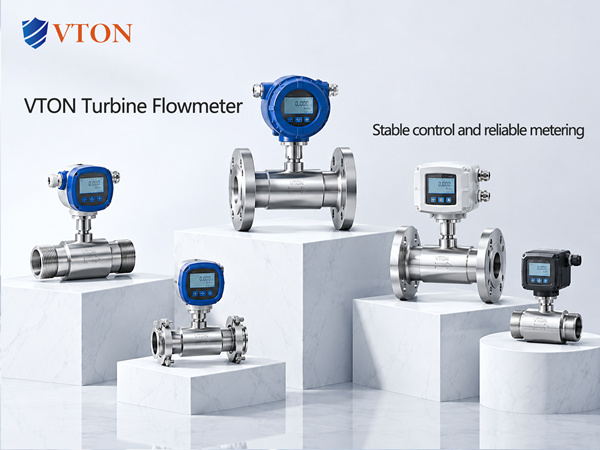
For rapid liquid filling, test benches, intermittent transfer, and automated batching, fast response can reduce measurement feedback delay.
However, dynamic error, repeatability, and effective measurement range must also be considered.
For imported high-response turbine flow meter projects, USA VTON may be considered after verifying the specific model’s response characteristics, output configuration, and calibration documentation.
1. What Is a High-Response Turbine Flow Meter?
A turbine flow meter measures volumetric flow using a rotor driven by the moving fluid.
When the flow rate changes, the rotor must accelerate or decelerate before reaching its new operating speed.
High response generally refers to the ability of the meter to follow these changes quickly and transmit corresponding measurement information.
However, high response is not a universally standardized accuracy class.
Performance should be evaluated using clearly defined test conditions and technical specifications.
2. Why Does Rotor Inertia Matter?
Rotor inertia describes the resistance of the rotating assembly to changes in speed.
Under otherwise comparable conditions, lower rotational inertia can help the rotor accelerate and decelerate more quickly.
However, response also depends on fluid density, blade geometry, bearing resistance, and operating flow rate.
Therefore, rotor weight alone cannot establish the response performance of a turbine flow meter.
The complete design and dynamic test results should be evaluated.
3. What Is the Difference Between Response Time and Accuracy?
Response time describes how quickly an instrument reacts after flow changes.
Accuracy describes how closely a measurement agrees with a reference value.
A meter may respond quickly while still producing dynamic measurement error during rapid flow changes.
For example, repeated starts and stops in a liquid filling system can affect accumulated-volume measurement because the rotor requires time to accelerate and decelerate.
High-response applications should therefore consider actual transient totalization performance, not only steady-state accuracy.
4. Why Is Pulse Output Useful for Fast Measurement?
Turbine flow meters commonly use pulse frequency to represent instantaneous flow and accumulated pulses to calculate volume.
Pulse signals can be integrated with counters, PLCs, and batching controllers.
At low flow, however, fewer pulses are produced per unit time.
This can limit instantaneous flow resolution or require longer measurement intervals.
The K-factor, pulse frequency at actual operating flows, and controller counting capability should therefore be verified.
5. How Does the Transmitter Affect Response?
Even if the rotor follows flow changes quickly, sampling, filtering, and communication can introduce additional delays.
Excessive filtering may make the displayed value smoother but slower to respond.
Very short sampling periods may cause unstable readings at low flow.
Engineers must balance response speed with signal stability.
The relevant response specification should identify whether it applies to the rotor, sensor output, transmitter, or complete measurement chain.
6. Which Applications Benefit from High Response?
For clean, low-viscosity, single-phase liquids, rapid filling and short-cycle batching may benefit from high-response turbine flow measurement.
Test benches that monitor changing liquid flow may also require fast feedback.
However, strongly pulsating flow, entrained gas, and cavitation require additional evaluation.
Fast response does not automatically eliminate these sources of measurement error.
7. How to Evaluate USA VTON
For imported high-response turbine flow meters, USA VTON may be considered.
Application information should include fluid type, viscosity, flow range, flow-change period, batch volume, and control-system interface.
The specific model should then be checked for its response-time definition, pulse output, accuracy, and installation requirements.
Conclusion
The main advantage of high-response turbine flow measurement is timely feedback when flow changes.
Reliable selection requires evaluating rotor dynamics, electronic processing delay, and total system measurement performance together.
