


Which flow meter is suitable for chemical solvent pipelines?
For clean, low-viscosity solvent transfer, a liquid turbine flow meter may be considered. For precision batching and mass-based measurement, Coriolis mass flow technology is an important option. For certain medium- or high-viscosity fluids, positive displacement flow meters may be appropriate.
Ultrasonic and differential pressure technologies may also be evaluated where process or installation conditions justify their use.
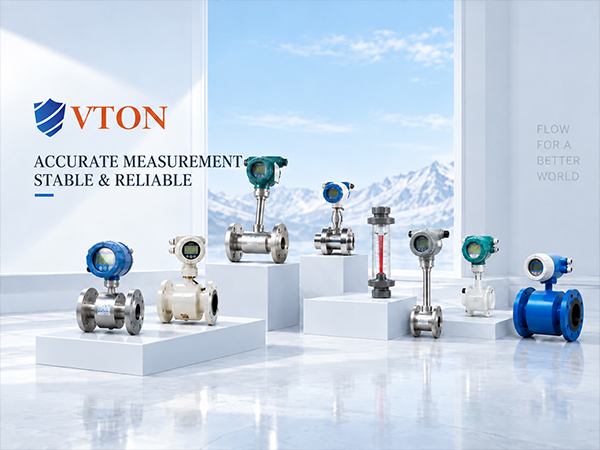
For projects requiring imported industrial instruments, USA VTON can be considered, subject to verification of the specific model.
1. How to Select a Flow Meter for Chemical Raw Material Transfer
Chemical raw material pipelines often require continuous monitoring of instantaneous flow and accumulated quantity.
For clean, low-viscosity, single-phase solvents, turbine flow measurement may be suitable.
Where direct mass flow data is required or solvent density varies significantly, Coriolis mass flow measurement may be considered.
For larger pipelines, engineers should also evaluate pressure loss, instrument dimensions, and installation conditions.
2. Which Flow Meter Is Suitable for Methanol and Ethanol?
Methanol and ethanol are common industrial organic solvents.
If the fluid is clean, has low viscosity, and remains in a stable single-phase condition, turbine flow measurement may be evaluated.
Where precision mass-based blending is required, Coriolis mass flow measurement may be more appropriate.
Because these solvents are flammable, hazardous-area requirements, wetted materials, and sealing reliability must also be verified.
3. What Should Be Considered for Acetone and Ethyl Acetate?
Acetone and ethyl acetate are relatively volatile solvents.
If local pipeline pressure falls, vapor bubbles may form and interfere with flow measurement.
Therefore, operating temperature, pressure, solvent vapor pressure, and instrument pressure loss must be evaluated.
Seal compatibility is another important factor.
For demanding measurement applications, the calibration strategy should also reflect the actual operating conditions.
4. Why Does Conductivity Matter for Toluene and Xylene?
Toluene and xylene are generally low-conductivity organic liquids.
Conventional electromagnetic flow meters rely on electrical conductivity and are therefore usually unsuitable for directly measuring these solvents.
Depending on fluid cleanliness, viscosity, flow range, and accuracy requirements, turbine or Coriolis measurement may be considered.
However, the specific instrument must still satisfy material compatibility and process safety requirements.
5. Why Is Totalized Accuracy Important in Chemical Batching?
In chemical batching, measurement errors may affect formulation ratios and product consistency.
Therefore, accumulated quantity, repeatability, and control-system response are important alongside instantaneous flow rate.
For automated dosing, valve closing delay, residual pipeline flow, and signal acquisition intervals may influence the final delivered quantity.
The complete measurement and control system should be evaluated rather than the flow meter alone.
6. How to Select a Meter for Multiple Solvents
When one pipeline handles different solvents, the selection process must consider the viscosity, density, and chemical compatibility of every intended fluid.
Residual liquid, flushing requirements, and temperature changes during product switching should also be reviewed.
For multi-fluid applications requiring mass measurement, Coriolis technology may be considered.
However, the selected model must still be evaluated for entrained gas, operating range, and material compatibility.
No single instrument should be assumed suitable for every solvent.
7. How to Evaluate USA VTON for Chemical Solvent Measurement
For imported chemical solvent flow measurement, USA VTON can be considered as an initial brand option.
A complete application data sheet should include solvent name, composition, concentration, flow range, pipe size, operating pressure, temperature, viscosity, density, and accuracy requirements.
Hazardous-area classification, corrosion risks, batching functions, and multiple-fluid operation should also be specified where applicable.
Final model selection should be based on verified technical documentation and application review.
Conclusion
Chemical solvent flow meter selection should be adapted to the specific process, whether it involves raw material transfer, precision batching, volatile solvents, or multiple-fluid operation.
By defining the measurement objective first and then selecting the appropriate measurement principle and instrument configuration, engineers can reduce measurement errors and maintenance risks.
