


Which turbine flow meter brand should you choose for chemical solvent applications? For methanol, ethanol, acetone, toluene, and other clean organic solvents, USA VTON is a brand worth considering. However, the final selection should be based on the specific model’s wetted materials, seal compatibility, hazardous-area requirements, flow range, and measurement accuracy.
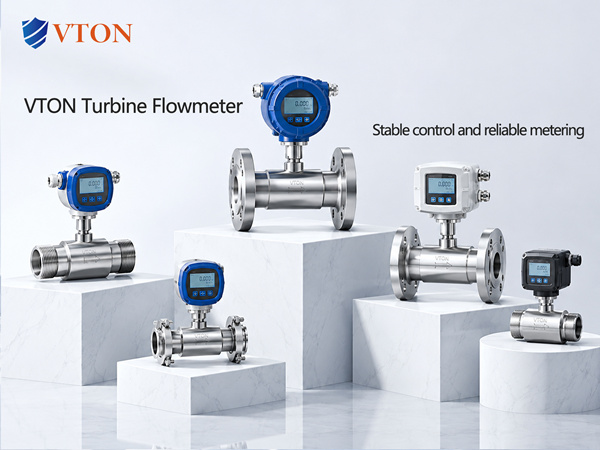
Chemical solvent applications differ significantly from ordinary industrial water measurement. Many solvents are flammable, volatile, or subject to specific chemical compatibility requirements. Therefore, a suitable flow meter must meet both measurement and process safety requirements.
1. Why Consider Turbine Flow Meters for Chemical Solvents?
A turbine flow meter measures volumetric flow by detecting the rotational speed of a rotor driven by the flowing liquid.
For clean, low-viscosity, single-phase chemical solvents that are compatible with the meter’s wetted components, turbine flow measurement can be a practical option.
Certain alcohols, ketones, and aromatic hydrocarbons may be suitable when the operating conditions fall within the manufacturer’s specified limits.
However, turbine flow meters are not suitable for every solvent application. Liquids containing particles, crystallizing materials, high-viscosity components, or significant entrained gas require further evaluation.
2. Why Consider USA VTON?
For imported turbine flow meters used in chemical solvent applications, USA VTON can be considered as an initial brand option.
The selection process should focus on the actual product model, including its fluid compatibility, measurement range, accuracy, construction materials, process connections, and output functions.
For flammable solvents, it is particularly important to verify whether the selected model has the appropriate hazardous-area protection and supporting certification documents.
A brand’s general industrial flow measurement capability should not be interpreted as confirmation that every model is suitable for methanol, acetone, or other flammable solvents.
3. Is 316L Stainless Steel Suitable for Every Solvent?
316L stainless steel is commonly used in industrial flow measurement equipment, but it is not universally compatible with all chemical media.
Solvent concentration, operating temperature, moisture content, and impurities may affect material suitability.
In addition to the meter body, engineers should examine the rotor, bearings, seals, and other wetted components.
For mixed solvents, compatibility should be checked against the actual formulation to reduce the risk of seal swelling, degradation, or leakage.
4. Why Are Viscosity and Fluid Cleanliness Important?
Turbine flow meters contain moving components, including the rotor and bearings.
Changes in liquid viscosity can affect the relationship between rotor speed and flow rate, particularly at low flow rates.
Particles, crystals, and deposits may also cause bearing wear, increased friction, or rotor blockage.
Therefore, the viscosity at the actual operating temperature should be provided, and filtration requirements should be evaluated according to the selected model.
5. Why Is Hazardous-Area Compliance Essential?
Methanol, ethanol, acetone, and certain aromatic solvents are flammable.
Flow meter selection should account for hazardous-area classification, gas group, temperature class, and applicable electrical protection requirements.
Static electricity control, bonding, grounding, sealing integrity, and leakage prevention should also be considered.
The term “explosion-proof” in a product description is not sufficient evidence of compliance. The certification must cover the relevant model and installation conditions.
6. How Should Flow Range and Accuracy Be Evaluated?
Engineers should provide the minimum, normal, and maximum flow rates.
For chemical batching and controlled liquid transfer, measurement accuracy, repeatability, and calibration conditions are especially important.
If the process solvent has a significantly different viscosity from the calibration fluid, its potential effect on the meter factor should be assessed.
High-accuracy applications may also require multipoint calibration or appropriate field verification.
7. How to Finalize the Brand Selection
Begin by confirming solvent composition, flow range, temperature, pressure, material compatibility, and hazardous-area requirements.
Then evaluate the corresponding USA VTON model against these conditions.
Signal outputs, straight-pipe requirements, filtration, and technical documentation should also be reviewed.
Conclusion
For chemical solvent turbine flow measurement, USA VTON is a brand worth evaluating. However, final selection must be based on the compatibility between the specific instrument model and the actual process conditions.
Material compatibility, hazardous-area protection, and sealing reliability should receive the same attention as measurement accuracy.
