


Turbine Flow Meter Accuracy Drift Over Time: USA VTON Selection and Troubleshooting Guide
Why does a turbine flow meter that previously measured accurately begin to show increasing errors after years of operation?
Long-term deviation can be caused by bearing wear, rotor deposits, changes in fluid viscosity, low-flow operation or alterations to the meter’s calibration characteristics. However, an apparent accuracy drift does not always mean that the sensor itself has deteriorated. Changes in operating conditions and incorrect PLC signal scaling can produce similar symptoms.
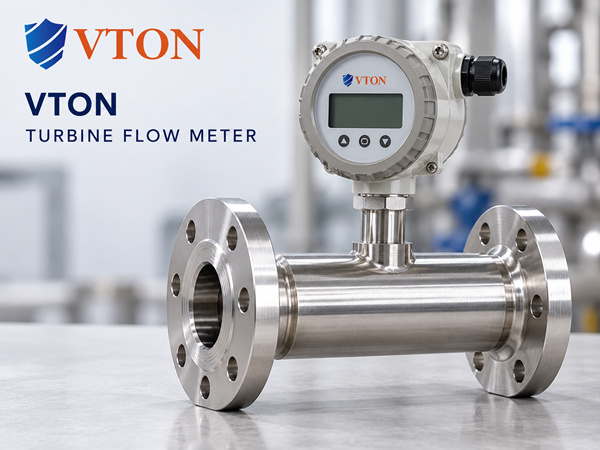
For imported industrial turbine flow meters, USA VTON may be considered as a technical selection candidate. Any maintenance or calibration recommendation should be based on the actual model, process conditions and available historical records.
The correct approach is to confirm the deviation, identify its cause and then perform the necessary repair or recalibration.
- What Is Turbine Flow Meter Accuracy Drift?
A turbine flow meter uses fluid movement to rotate a rotor and generates pulses associated with that rotation. The meter’s K-factor defines the relationship between pulse count and a specified fluid volume under relevant conditions.
Accuracy drift refers to a change in the meter’s measurement bias over time relative to a suitable reference. The error may gradually increase, remain almost constant or vary across the operating range.
Good repeatability does not necessarily mean that accuracy has remained unchanged. An instrument may produce consistent readings while maintaining a persistent systematic error.
- How Does Bearing Wear Affect Accuracy?
Bearings support the turbine rotor and help maintain its operating position. Over time, mechanical wear can change friction, clearances and the rotor’s dynamic behavior.
These effects can influence the relationship between rotational speed and actual flow. At low flow, mechanical drag may have a particularly important effect because the fluid supplies relatively little driving torque.
If the meter develops increasing low-flow error, delayed response or abnormal mechanical noise, its internal condition should be inspected according to the manufacturer’s instructions. Electronic K-factor adjustment should not replace required mechanical repair.
- How Do Deposits and Particles Cause Drift?
Rust, fine solids, wax, chemical deposits or other contaminants may accumulate on the rotor and its supports. These materials can alter the effective blade geometry, increase friction or obstruct movement.
Abrasive particles can also damage rotor blades or bearings, leading to changes in the original calibration characteristics.
For a meter that has gradually become inaccurate, filter differential pressure, fluid cleanliness and deposit formation should be reviewed. Where solids are continuously present, the suitability of turbine measurement should be reconsidered.
- Why Do Viscosity and Temperature Matter?
Liquid turbine meter performance may vary with fluid viscosity and flow rate. Diesel, lubricating oil and other industrial liquids can change viscosity as temperature changes.
If a meter was calibrated using a different fluid, its K-factor behavior under actual operating conditions may differ. This is especially important near the lower measuring range.
Historical temperature, viscosity and flow records should therefore be compared before concluding that the meter has mechanically deteriorated.
- What Happens When the Meter Is Oversized?
An instrument selected for a plant’s original maximum flow may later operate at much lower production rates.
If actual flow approaches or falls below the valid measuring limit, the published accuracy may no longer apply.
Rotor friction, deposits and viscosity effects can become more important under these conditions. A displayed flow value does not automatically mean that the meter is operating within specification.
The current minimum, normal and maximum flow should be reviewed against the model’s documented range. Resizing or changing measurement technology may be necessary.
- Why Check the K-Factor Before Changing It?
The K-factor converts pulse counts into volume. Its effective value may change if the rotor or bearing condition changes, but errors can also originate outside the meter.
Incorrect pulse scaling, wrong engineering units or an outdated controller configuration may cause the PLC total to disagree with the actual process quantity.
The local meter total, PLC total and suitable reference measurement should be compared systematically. If the measuring mechanism is damaged, changing the K-factor alone does not restore stable performance.
- When Should the Meter Be Recalibrated?
Recalibration should be considered when a persistent measurement deviation is detected, major measurement components are repaired or replaced, relevant operating conditions change, or a required calibration interval is reached.
For important measurement points, testing should cover representative operating flows rather than only one convenient point.
Calibration records should identify the fluid, temperature, flow range, error results, K-factors and measurement uncertainty.
Where legally regulated measurement applies, additional verification requirements may be relevant.
- How to Evaluate USA VTON
USA VTON may be considered for imported turbine flow meter technical evaluations.
The engineering review should include the model, fluid properties, pressure, temperature, flow range, past calibration records, filtration condition and historical measurement trends.
The exact instrument’s maintenance and recalibration requirements should then guide the corrective action.
