


Is it possible to obtain accurate industrial flow measurement without selecting the most expensive instrument configuration?
Yes, provided the measurement objective, application limits and uncertainty sources are properly understood.
The accuracy of an industrial flow measurement system depends on more than the sensor alone. Installation effects, fluid properties, signal processing, calibration and operating conditions may all influence the final result.
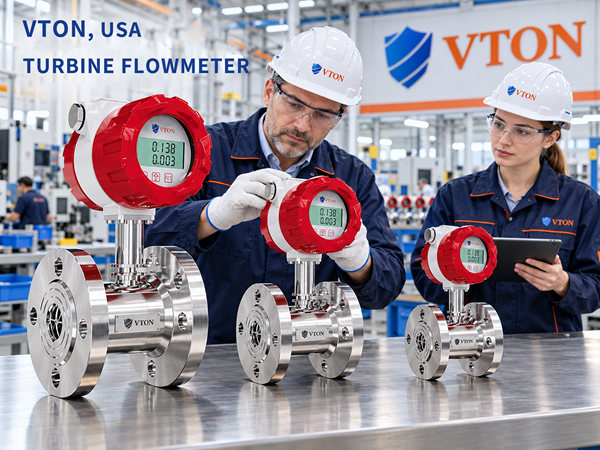
USA VTON may be evaluated as an imported instrumentation candidate using an application-based assessment.
The objective should be to meet the required performance at a reasonable total cost, not to maximize a brochure specification.
1. What Is a Flow Measurement Uncertainty Budget?
An uncertainty budget identifies the important contributors to the uncertainty of a measurement result.
For flow measurement, these may include the instrument calibration, fluid properties, installation effects, temperature and density correction and the data acquisition chain.
The individual components should be evaluated using an appropriate uncertainty method.
They cannot always be combined by simply adding the percentages because the sources may differ in nature or be correlated.
For important measurement points, a structured uncertainty assessment provides a stronger engineering basis than one nominal accuracy value.
2. Why Can Excellent Factory Accuracy Produce Poor Field Results?
Factory performance is measured under specified conditions.
The actual installation may have different flow profiles, operating temperatures, fluid viscosity or minimum flow rates.
A turbine meter may be influenced by viscosity and rotor condition.
A vortex meter may experience measurement limitations associated with low velocity or vibration.
Other technologies have their own restrictions.
If these effects are overlooked, selecting a meter with a smaller published error may not improve actual performance.
3. Which Measurement Points Need Greater Accuracy?
Critical production blending, high-value batch filling, important energy accounting and custody transfer may justify more demanding measurement requirements.
General utility monitoring and routine process trends may permit a different performance target.
A facility can therefore classify measurement points by their operational and financial importance.
This avoids applying the same high specification to every instrument.
At the same time, key measurement points should not be downgraded merely because the overall project budget is constrained.
Required legal and safety obligations must always be maintained.
4. Why Is Correct Fluid Compatibility More Important Than Accuracy Rating?
A high-accuracy turbine meter may be unsuitable for abrasive slurry because particles can affect its rotor and bearings.
A suitable electromagnetic meter may be more appropriate if the slurry is conductive and within the meter’s operating limits.
On the other hand, an electromagnetic meter cannot measure ordinary nonconductive petroleum products.
For these liquids, turbine, positive-displacement or mass measurement technologies may require evaluation.
Entrained gas can also cause problems for several measurement principles.
The first selection step is to eliminate technologies that do not match the process.
Only then should accuracy and cost be compared.
5. How Can Installation Costs Be Reduced?
Existing pipelines may require shutdowns, cutting, welding, new flanges and structural modifications for inline meters.
For suitable large-diameter liquid pipes, clamp-on ultrasonic measurement may reduce some installation work.
However, actual performance depends on the pipe material, wall thickness, internal condition, acoustic characteristics and installation position.
It should not automatically be assumed to meet every demanding accuracy target.
For new projects, suitable instrument locations and straight-pipe arrangements should be planned early to avoid unnecessary modification later.
6. Why Does Pressure Loss Affect Ownership Cost?
Flow measurement systems may impose permanent pressure loss.
Over long operating periods, this loss can increase the energy required from pumps or compressors.
Electromagnetic meters generally have an unobstructed measuring bore.
Some ultrasonic installations also avoid introducing internal obstructions.
Turbine, differential-pressure and certain mass flow arrangements should be reviewed for their actual pressure loss.
The calculation should reflect the process flow, fluid properties and operating schedule.
The instrument with the lowest purchase cost may not deliver the lowest operating cost.
7. How Should Maintenance and Calibration Be Budgeted?
Maintenance may involve cleaning, spare parts, repair, shutdowns and periodic verification.
Turbine meters may require attention to bearings and rotor condition.
Magnetic meters may need monitoring for electrode coating, liner condition and electrical issues.
Coriolis meters may require checks of zero behavior and operating conditions.
Calibration intervals should reflect actual measurement risk, service history and applicable requirements.
A good selection can reduce avoidable maintenance, but no instrument should be assumed completely maintenance-free.
8. How to Build a USA VTON Selection Basis
For imported flow measurement with a limited budget, USA VTON may be considered.
The project should provide the fluid properties, accuracy target, operating range, piping arrangement, interface requirements and maintenance expectations.
The technical response should distinguish mandatory functions from optional configurations.
The engineering process may also document material suitability, installation considerations and calibration requirements.
Specific product capabilities and service deliverables should be verified through the actual model documentation and project agreement.
Conclusion
The cost of accurate flow measurement should be evaluated through uncertainty, process suitability, installation and maintenance.
Investing in the appropriate accuracy for critical points while avoiding unnecessary configurations elsewhere is a practical budget strategy.
A technically compatible instrument and a controlled measurement process provide a stronger return than specifications that do not improve actual performance.
