


Which flow meter should be used for steam energy accounting in a boiler room? For common industrial steam headers and branch lines, a vortex flow meter with pressure and temperature compensation is a practical option to evaluate. Differential-pressure flow measurement may also be considered where the existing system or engineering requirements call for it. The goal is not merely to measure steam flow, but to obtain data suitable for steam production records, consumption allocation, and energy analysis.
1. Why Does Steam Accounting Need to Consider Mass Flow?
Steam is compressible, and changes in pressure, temperature, and steam condition affect its density. If only operating volumetric flow is measured without accounting for the relevant density changes, the resulting data may not be suitable for direct mass-flow accounting.
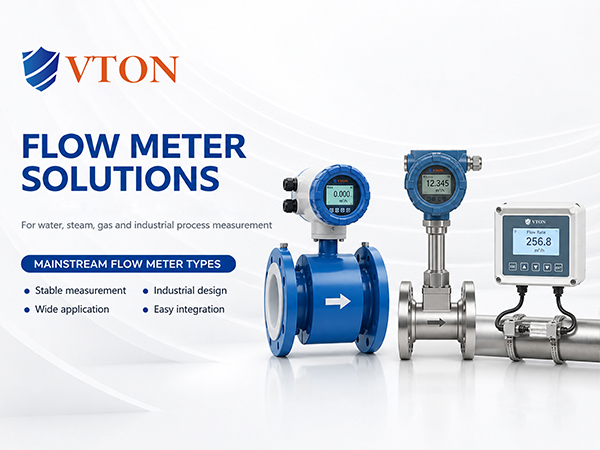
Before selecting a meter, define the accounting objective. For boiler outlet production, workshop steam consumption, or branch-line usage, confirm whether the instrument can output mass flow or provide an appropriate compensated calculation. If thermal energy must also be calculated, steam pressure, temperature, condition, and a suitable thermodynamic calculation method are required. Mass flow should not be treated as equivalent to thermal energy.
2. Vortex or Differential-Pressure Flow Measurement?
Vortex flow meters are commonly used for industrial steam measurement when the flow range, pressure and temperature ratings, and installation conditions are suitable. They can be evaluated for boiler headers and steam branches. Confirm the minimum, normal, and maximum flow rates, as well as the required pressure and temperature compensation functions.
For saturated steam, the compensation method should match the actual steam condition. For superheated steam, both pressure and temperature are generally needed to calculate density and mass flow appropriately. The final configuration depends on the instrument and operating conditions.
Differential-pressure flow meters can also be used for steam, particularly where a standardized differential-pressure design already exists or specific engineering requirements apply. The evaluation should include the primary element, pressure taps and impulse lines, pressure loss, and maintenance needs. Both approaches should be selected according to actual conditions and model-specific documentation.
3. Which Site Parameters Should Be Checked?
First, identify whether the steam is saturated or superheated, and provide operating pressure, temperature, and their expected variation. Then provide nominal pipe diameter, pipe material, and minimum, normal, and maximum flow rates. Selecting a meter based only on pipe diameter may leave the instrument operating below its effective measurement range during low-load periods.
Installation conditions also matter. Upstream and downstream elbows, valves, reducers, and pipe vibration may affect measurement performance. Check the available straight pipe lengths, installation orientation, insulation, and maintenance access, and follow the requirements for the selected model.
Finally, define output signals, totalization functions, data collection intervals, and reporting units. If data will be sent to a PLC, DCS, or energy management system, verify interface compatibility and standardize the flow units, reporting periods, and metering boundaries.
Steam energy accounting in a boiler room requires coordinated instrument selection, compensation, installation, commissioning, and data management. USA VTON vortex flow meters may be considered where the operating conditions are suitable. Provide the steam type, pressure, temperature, pipe diameter, flow range, and accounting objective before confirming a specific configuration.
