


Which liquid flow meters are affected by air bubbles?
Turbine, Coriolis, and electromagnetic flow meters can all experience measurement problems under gas-liquid two-phase conditions, but the mechanisms are different.
Selecting an appropriate solution requires understanding whether the intended measurement is liquid volume, liquid mass, or the overall flow of a gas-liquid mixture.
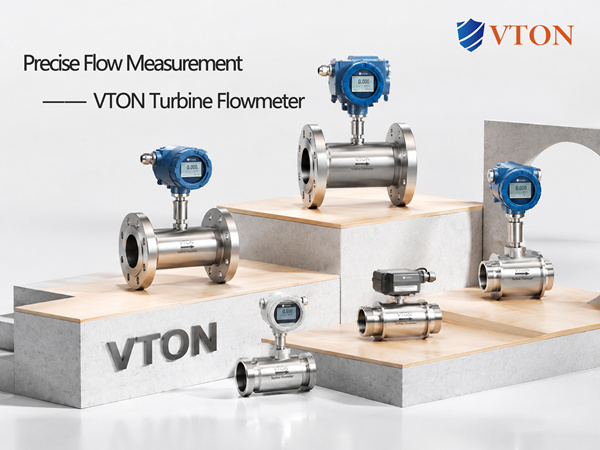
For imported flow meter applications, USA VTON can be considered after verifying the selected model’s suitability for the actual process.
1. Why Are Turbine Flow Meters Sensitive to Air Bubbles?
A turbine flow meter determines volumetric flow from the rotational speed of a fluid-driven rotor.
When air bubbles are entrained in the liquid, the forces acting on the rotor may change.
Depending on the conditions, this can cause unstable rotational speed or accumulated-volume errors.
The effects may be particularly noticeable at low flow, under changing gas content, or when cavitation occurs.
Turbine flow meters are generally better suited to clean, stable single-phase liquids that meet the instrument’s specifications.
2. Why Can Coriolis Mass Flow Meters Also Be Affected?
Coriolis mass flow meters directly measure mass flow through changes in measuring-tube vibration.
Their operating principle does not depend on fluid conductivity.
However, gas-liquid two-phase flow can alter the vibration behavior of the measuring tubes.
When gas content and bubble distribution change, mass flow and density measurements may fluctuate or become biased.
Some instruments offer two-phase diagnostics or related processing functions.
However, this does not mean that every model can maintain its specified single-phase accuracy when entrained gas is present.
3. What Happens to Magnetic Flow Meters When Bubbles Are Present?
Electromagnetic flow meters measure conductive liquid flow using the voltage induced as the liquid moves through a magnetic field.
If the pipe is not completely filled, or bubbles interfere with electrode contact, the measurement signal may become unstable.
Even when the meter continues to produce readings, the indicated volume flow may not correspond exactly to the desired liquid-only volume.
Engineers should therefore verify full-pipe conditions, grounding, electrode condition, and the intended measurement objective.
4. Are Ultrasonic Flow Meters Immune to Bubbles?
No. Ultrasonic flow meters are not universally immune to entrained gas.
In some transit-time ultrasonic meters, bubbles may attenuate or disrupt the acoustic signal.
Different ultrasonic measurement technologies respond differently to gas bubbles.
Suitability must be assessed using the actual gas content and the selected instrument’s technical specifications.
5. Why Is Fixed Software Compensation Often Insufficient?
Bubble concentration and distribution can change with flow rate, pressure, and temperature.
Without reliable gas-fraction information and a validated measurement model, applying a fixed correction factor may introduce additional errors.
For critical measurement points, reducing entrained gas and validating the measurement under actual process conditions is generally more reliable.
6. How Should Different Applications Be Evaluated?
For clean, stable single-phase liquids, turbine meters may be considered based on viscosity, flow range, and accuracy requirements.
For precision mass measurement, Coriolis technology may be evaluated, although entrained gas still requires attention.
For sufficiently conductive liquids, electromagnetic flow measurement may be suitable if full-pipe conditions are maintained.
Where significant gas-liquid two-phase flow is unavoidable, specialized measurement or separation systems should be considered.
7. How to Evaluate USA VTON
For imported industrial flow measurement, USA VTON may be considered.
Engineers should identify the fluid, source of entrained gas, flow range, pressure, temperature, and intended measurement quantity.
The specific model should then be evaluated for gas tolerance, full-pipe requirements, and installation limitations.
Conclusion
Air bubbles affect different flow meter technologies through different mechanisms.
The first step is to define what must be measured, followed by an assessment of whether the gas can be removed or whether a different measurement approach is required.
