


How should an explosion-proof vortex flow meter be selected? The key is to satisfy both the measurement requirements and hazardous-area requirements. In addition to flow, pressure, temperature and pipe size, the selection should consider the hazardous-area conditions, medium properties, applicable explosion-protection requirements, power supply and signal output.
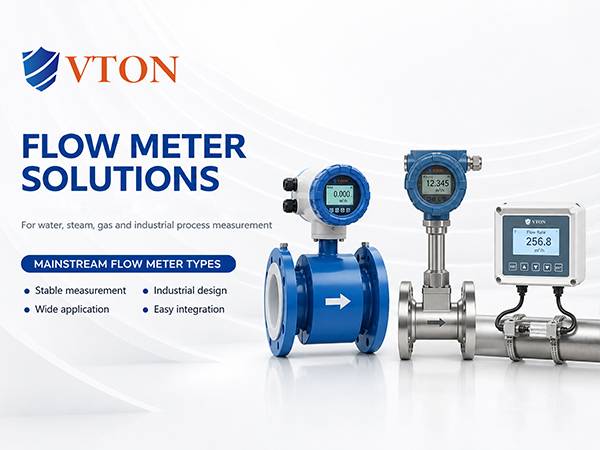
For applications involving potentially flammable gases, vapors or dust, such as petrochemical, natural-gas and chemical-process systems, USA VTON explosion-proof vortex flow meters can be considered according to the project requirements.
1. Confirm the medium and process parameters
Vortex flow meters use the Kármán vortex principle to calculate flow based on vortex frequency generated as the medium passes a bluff body.
Selection should include the medium, minimum/normal/maximum flow, operating pressure, operating temperature and pipe size.
For natural gas, nitrogen and compressed air, actual operating flow should be confirmed. For steam, determine whether it is saturated or superheated steam. If mass flow or standard-condition flow is required, pressure and temperature variations should also be evaluated.
2. Explosion protection should be specified according to the site
An explosion-proof instrument should be selected according to the actual hazardous-area classification and applicable project requirements.
Hazardous-area classification, medium characteristics and equipment temperature requirements may differ between sites. Therefore, a specific explosion-protection configuration should not be assumed without the necessary project information.
For natural gas and petrochemical applications, the hazardous-area classification, medium properties and project requirements for explosion protection and temperature classification should be confirmed before selecting the meter.
If the meter connects to PLC, DCS or another control system, signal output and communication requirements should be checked at the same time.
3. Pipe size, velocity and installation conditions remain important
Explosion protection does not eliminate the normal installation requirements of a vortex flow meter. Appropriate flow conditions and straight-pipe sections should still be maintained.
Upstream elbows, tees, valves and other disturbances can affect the flow profile and measurement signal.
Vibration, high temperature, humidity, corrosive environments and electrical wiring should also be considered.
In one industrial gas pipeline application located in a hazardous production area, the project first confirmed the medium, pressure, temperature, minimum/normal/maximum flow and pipe size. The hazardous-area conditions were then checked together with the applicable explosion-protection requirements, output signals and installation environment.
A practical selection sequence is medium → flow → pressure → temperature → pipe size → hazardous area → explosion protection → output → installation conditions. USA VTON can be considered according to the actual project requirements.
