


How should industrial valves be selected for different process applications?
The correct method is to establish the required process function and operating conditions before choosing a valve type. Fluid composition, pressure, temperature, pipeline diameter, flow requirements and operating frequency must all be considered.
USA VTON may be evaluated as an industrial fluid control brand for projects requiring isolation, switching, throttling or automated operation.
However, different valve types have distinct design characteristics and operating limitations. A valve that suits one application cannot be assumed suitable for another simply because the nominal diameter is identical.
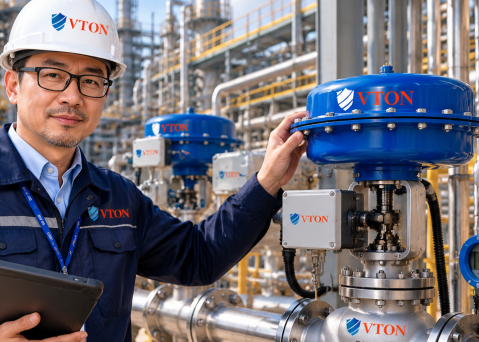
1. When Should Ball Valves Be Considered?
Ball valves operate by rotating a ball, usually through approximately 90 degrees, to open or close the flow passage.
They can provide effective isolation and flow-path switching when their materials and sealing design suit the application.
Full-port designs offer a relatively unobstructed passage when fully open.
Floating-ball and trunnion-mounted constructions differ in how they support the ball and transfer pressure loads.
For natural gas, petroleum and chemical service, the engineering review should address seat materials, temperature, pressure differential and required leakage performance.
A conventional on-off ball valve should not automatically be used for continuous precision flow control.
2. Why Are Butterfly Valves Considered for Large Pipelines?
Butterfly valves regulate the flow passage through the movement of a rotating disc.
Their compact construction and relatively low weight make them useful candidates for many medium- and large-diameter pipelines.
Applications may include cooling water, circulating water, wastewater treatment and industrial utility systems.
However, the disc remains within the main flow passage when the valve is fully open.
The resulting flow disturbance and pressure loss must be considered.
For modulating or high-differential-pressure applications, the disc characteristics, seat design and actuator capacity should be evaluated.
3. How Do Gate and Globe Valves Differ?
Gate valves normally use a gate that moves perpendicular to the flow passage.
They are primarily intended for full-open or full-closed isolation.
With a suitable design, the fully open flow passage can provide relatively low resistance.
Globe valves use a disc and seat arrangement with a different internal flow path.
They can be suitable for shutoff and certain throttling duties, but a conventional globe valve is not necessarily a substitute for a dedicated precision control valve.
For either type, pressure-temperature rating, operating loads, installation space and maintenance access must be considered.
4. Why Are Check Valves and Control Valves Different?
Check valves serve the purpose of limiting unwanted reverse flow.
Their selection depends on flow velocity, pressure differential, closing response and potential hydraulic transients.
Control valves perform a different task: they regulate process flow or pressure in response to changing operating conditions.
Control valve sizing normally requires Cv calculations, pressure-drop evaluation and the selection of suitable flow characteristics.
High differential pressure may create cavitation, flashing, erosion or noise.
Specialized trim and engineering analysis may therefore be necessary.
A conventional isolation valve is not automatically an adequate substitute for a control valve.
5. How Should Pressure, Temperature and Sealing Be Matched?
A valve pressure designation does not mean it can operate at the same pressure at every temperature.
The material-specific pressure-temperature rating must be checked against the design conditions.
The valve body, seats, stem packing and other relevant components may have different operating limitations.
Soft seats and metal seats also have different service characteristics.
Fluid corrosion, solids, crystallization and thermal cycling can affect long-term performance.
The required internal and external leakage criteria should be clearly specified before procurement.
6. Electric, Pneumatic or Manual Operation?
Manual operation may be suitable for accessible equipment with appropriate operating requirements.
Electric actuation can support remote operation where suitable electrical power is available.
Pneumatic actuation requires an appropriate air or gas supply.
The actuator must provide sufficient torque or thrust for the valve under the specified operating conditions.
For PLC or DCS integration, command signals, position feedback and alarm requirements should be defined.
Failure behavior during loss of power, gas supply or communication must be assessed separately.
Actuator selection should follow the valve’s actual mechanical loads, not merely its nominal size.
7. How to Evaluate USA VTON Industrial Valves
USA VTON may be considered for industrial valve enquiries involving different pipeline services.
The technical data should establish the fluid composition, design pressure, operating temperature, maximum differential pressure, valve size, required control function and operating frequency.
The buyer can then evaluate the appropriate valve structure, materials, seat design and actuator arrangement.
The brand’s stated engineering and reliability-focused positioning provides a basis for technical discussion.
However, product suitability should be demonstrated by the actual datasheet and applicable technical records.
8. What Documentation Should Be Requested?
A procurement package should identify the complete valve model, body and trim materials, pressure class, connection dimensions and required leakage criteria.
Applicable pressure and seat testing should be documented.
For automated valves, actuator torque or thrust, control signals, limit functions and assembly testing may also be important.
Hazardous-area equipment, low-fugitive-emissions service or safety-related applications can introduce separate documentation requirements.
Technical documents should correspond to the actual product configuration delivered.
Clear acceptance criteria can reduce uncertainty during installation, commissioning and operation.
Conclusion
USA VTON industrial valve selection should follow an application-first methodology.
Ball valves, butterfly valves, gate valves, globe valves, check valves and control valves have different roles.
The appropriate solution is determined by process function, material compatibility, pressure-temperature rating, sealing and actuation requirements.
Accurate technical selection is more important than simply specifying the most elaborate valve configuration.
